 By admin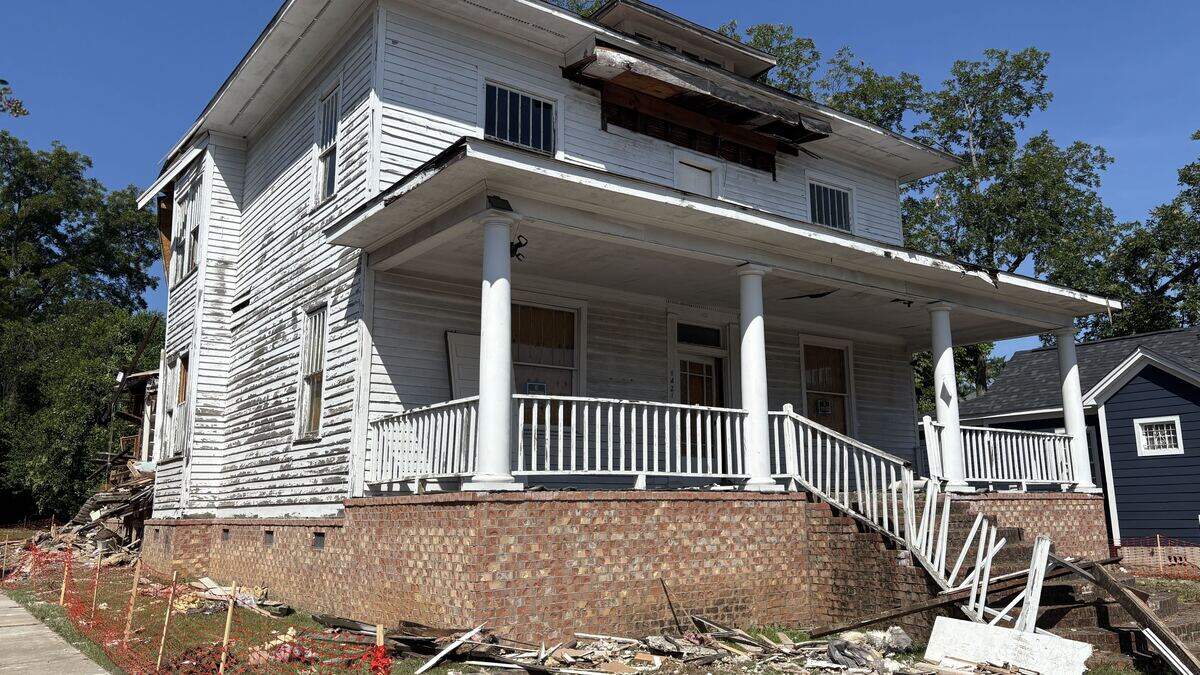
Nearly twenty years ago, Allen University took a historic home where one of its past presidents had lived and moved it two blocks over to make room for new dorms.
Read more Oil gains on Middle East supply concerns amid impasse in US-Iran war
As part of the relocation, the university promised to restore the home to a livable condition, so future presidents could live there, too. But that never happened.
Now, the deteriorating Robert Weston Mance House on Heidt Street, less than half a mile from the university’s core, is coming down. The demolition comes after a years-long legal battle to try to save the house, and as a neighborhood leader has called it a safety issue and has lobbied for it to be razed.
Historic house tied to Civil Rights
Today, the two-story American Foursquare frame house is a sea of broken beams, tufts of insulation and general rubble. Crews have started to take the building down. Teeth of a wooden railing hang loose and sharp from the front porch. The door is boarded but ajar. Two large black dumpsters overflow with more of the home’s detritus in the front yard.
The city has also formally deemed it an unsafe structure.
But once, it was home to multiple generations of Columbia civil rights leaders.
Built in 1903, the house originally stood on the corner of Pine and Hampton streets. It became known as the Mance House after the Rev. Robert Weston Mance bought it in 1922 while serving as president of Allen University. Mance lived there with his family, including his son, Dr. Robert Weston Mance Jr.
Mance Jr. was a physician and educator who later became superintendent of Waverly Hospital.
Waverly itself became a self-sustaining Black community, where African American leaders built businesses and institutions during segregation. Those included the Waverly Five & Dime, run by George Elmore, one of the men who successfully sued for the right for Black South Carolinians to vote in primary elections.
Also in the district was Waverly Hospital, founded by African American Dr. Norman A. Jenkins to provide medical care to Columbia’s Black community during segregation. The hospital later became part of Good Samaritan-Waverly Hospital.
Allen University and Benedict College served as anchors of the community. The Waverly Historic District was listed on the National Register of Historic Places in 1989 and added to the National Park Service’s African American Civil Rights Network in 2021.
Preserving Waverly’s history is important, said neighborhood association president Ronald Davis, but not at the expense of safety.

“I understand the significance of the building and how important it is, and history is important, but safety is my top priority as president of Historic Waverly, and I will not waver on that in any way,” Davis told The State.
The house has sat empty since its 2008 relocation. Before that, it was used for storage and office space. Since its move, windows have been broken, paint has chipped, and code violations at the property have stacked up.
The Historic Waverly neighborhood already has too many abandoned homes, Davis said.
He had seen what he described as college students and homeless individuals going into the house. He said he worries about the roof caving in, or someone starting a fire.
Allen University, Davis said, had an opportunity to prevent the house from reaching that point.
“They did absolutely nothing to fix that building,” he said.
The State has contacted representatives for Allen University with questions about the house, but has not received a response.
A promised restoration never came
The historic home was in the way in 2008, when Allen University was in the midst of an $18 million dorm expansion on its campus. So, the house was relocated to its current position at 1421 Heidt St. The deal was that the university would relocate the house and then restore it, a stipulation for receiving a financial guarantee for the dorm project and the relocation effort from the federal Department of Education.
At the time, then-university president Charles Young said, “The Mance House has been an important part of Allen’s history, and we are proud we have been able to save it.”
But the work to repair the home never came. Fifteen years later, in 2023, neighbors noticed a wrecking crew at the property. A portion of the roof had been removed, but no demolition permit had been issued.
Allen University was ordered to stop the demolition and seek formal permission from the city. In February 2023, the city’s Design/Development Review Commission rejected that formal request, with city preservationists saying the house still had good bones.
“While the building has suffered damage from years of neglect, preservation staff agreed that it appeared to be structurally sound and was not in as severe a state of disrepair as many historic buildings that we visit,” city staff wrote in a report to the design commission after a visit to the site in 2023.
Allen leadership told the design board members during that meeting that restoring the property would be expensive, with one firm estimating the work at over $500,000.
“Allen University isn’t in the Waverly district to hurt it, but we have to make decisions that are applicable to the university,” Eric Gamble, Allen’s vice president of planning and information technology at the time, told DDRC members. Gamble also explained that the school’s CEO and board of trustees had voted to demolish the property.
The design board voted 4-1 to deny the demolition permit, and Allen sued over the ruling. The issue stayed in court for over two years before the parties agreed to dismiss the matter.
Davis said his continued lobbying of city officials helped bring the years-long dispute to an end and paved the way for the demolition permit.
The city this summer approved a permit for the building’s demolition.
One house falls, others deteriorate
Davis said the Mance House is just one of several homes in Historic Waverly that have been left vacant and allowed to deteriorate.
He said he has reported at least five abandoned houses in the neighborhood that have been empty for years to code enforcement, some with caved-in roofs and broken windows.
“They’re fighting about the Mance house, and we’ve got all these other houses here just sitting here,” Davis said. “You’re looking at almost eight vacant houses that nobody lives in … These houses too will deteriorate, and they are deteriorating.”
The city has also approved a permit for the demolition of 2116 Lady St., an abandoned 1950s-era home a couple blocks away.
Davis said he wants city and state officials to put more money into helping Waverly property owners repair and maintain the homes, arguing that preservation does little good if residents don’t have the resources to keep historic properties standing.
“This is one of the oldest Black communities there is, and yet if you ride through this community, I want you just to ride through here and see how many houses are closed,” Davis said. “Nobody, nobody’s living in them.”
John Sherrer, director of preservation at Historic Columbia, agreed that he was disappointed Allen University didn’t make good on its promise to save the Mance House.
The house was moved in 2008 with “a lot of hope and expectation” for its future, Sherrer said. Instead, it was left to decay.
“Once the landmark’s gone, it’s gone,” Sherrer said. “You really do develop kind of cultural amnesia over it.”
Historic Columbia does not believe every old building needs to be saved, Sherrer said. But historic buildings provide physical touchstones to the past, and losing them means losing more than the structures themselves.
“You do lose a great deal of things that are not just the bricks and mortar,” he said. “You lose potential, all the energy that is invested in that building.”
Read more Key moments in Prince Harry and Meghan’s six years in California