 By admin
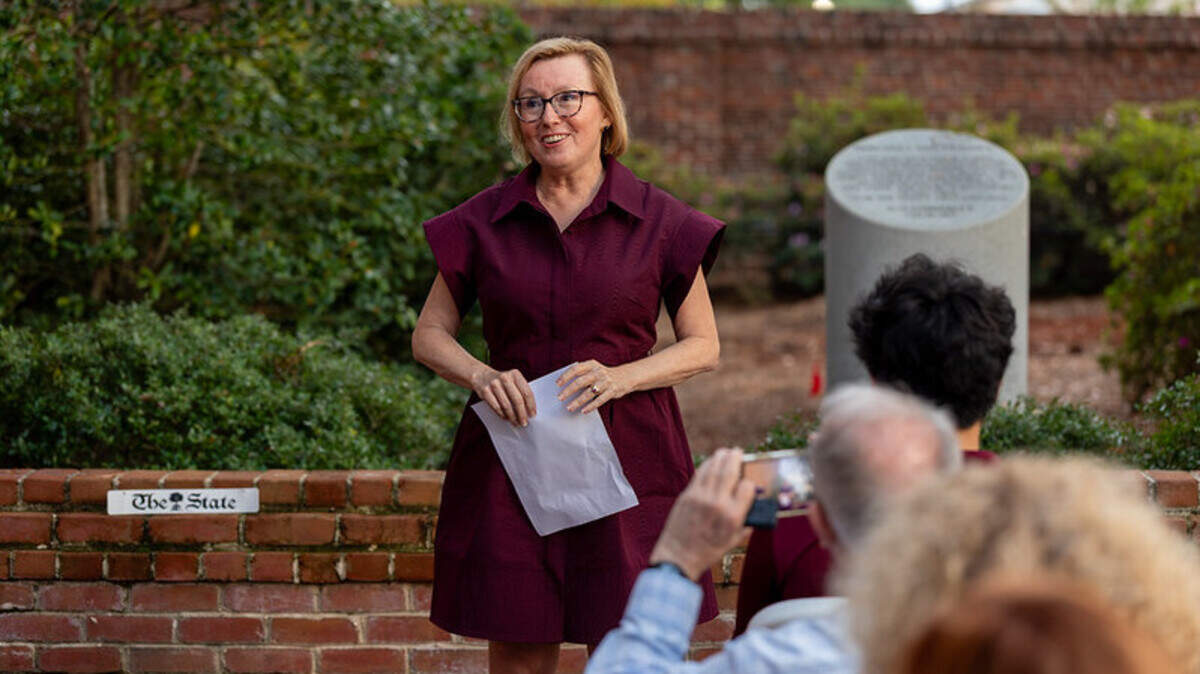
In 1991, the 100th anniversary of The State, journalists at its then-modern three-story headquarters on a 23-acre site on Shop Road dedicated a time capsule and installed it near the building’s front doors, where it stood until April, when demolition crews tore it down. Apartments now stand on the 23-acre site.
Read more What to do if the FAA’s nationwide ground stop delays or cancels your flight
The gray cylindrical capsule was saved.
It now stands in a garden just outside the front of University of South Carolina School of Journalism and Mass Communications. It is to be opened 15 years from now, on Feb. 18, 2041, the 150th anniversary of the founding The State.
Last Friday afternoon, at the start of Homecoming weekend, J-School faculty, students and a sprinkling of former and current State journalists gathered to commemorate the dedication of the monument at its new home.
“We at our 103-year-old journalism school accept this monument — and the mysterious time capsule — into our care. It will watch over us as we continue the important mission of journalism that for more 250 years has helped us keep our democracy,” said Nina Brook, a former State editorial writer and now a J-school senior instructor who helps shape curriculum.
“This monument saw a lot,” Brook continued. “For 35 years, some of our state’s finest journalists came and went to work by it. People who wanted to be U.S. president came by, headed to seek an all-important endorsement. Columbians who wanted to sell a car, rent out a house and hire help, came and bought classified ads. People paid for their subscriptions and bought umbrellas with the comics on them.”
The State and the J-School
Journalism school dean Tom Reichert recalled that the history of USC’s journalism school is intertwined with that of The State newspaper.
The J-School’s first dean, William Watts Ball, took a $3,000 pay cut in 1923, leaving his $6,000-a-year job at The State where he worked as editor, to help launch the university’s foray into educating young journalists, Reichert said.
Read more Scout Motors’ SC factory is 85% complete and first test vehicles are rolling off the line
“We were founded out of The State, and we’ve kept those bonds strong,” Reichert said. “It is something that we hold very dearly.”
Reichert said that whenever he meets alumni, “One thing I’ve discovered, everybody has either worked at The State, interned at The State, has some connection to The State. At least half of our colleagues in our faculty have ‘done time’ at The State.”
It was no easy matter to place the monument at the J-School, Reichert said. The USC board of trustees had to approve it and so did the university architect, Reichert said. There were debates about where to site it, and a crane was needed to lift it up.
“All of us agree this is the best spot,” Reichert said.
In her talk Brook also recalled that bravery and bloodshed are part of the paper’s tradition. The State’s first editor, N.G. Gonzales, was assassinated by a political rival in 1903 at the corner of Main and Gervais streets, just a few blocks from where the time capsule stands.
The words of Gonzales, from The State’s first editorial, are inscribed on the top of the time capsule:
“They sail with clean hands and honest hearts intent on good. Theirs is a venturesome voyage no doubt, and one on which timid spirits would not embark, but it is a mission of duty and honor and right, and there is no coward in the crew.”
Read more What to do if the FAA’s nationwide ground stop delays or cancels your flight