 By admin
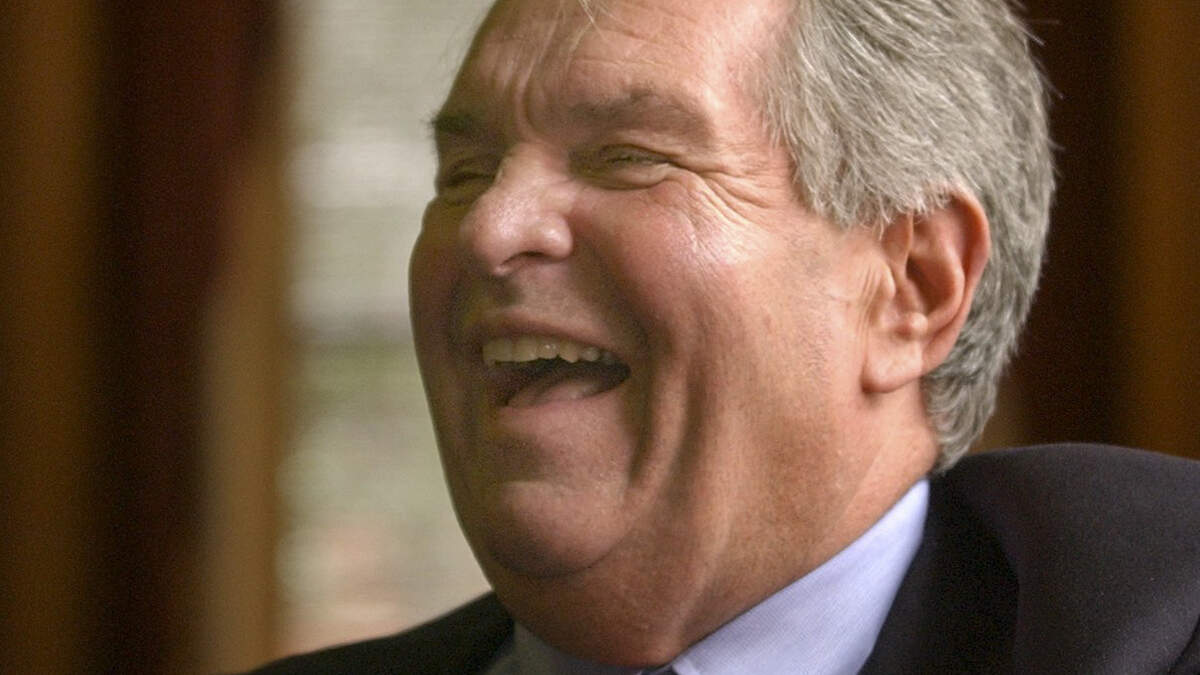
Alex Sanders, a former chief judge of the SC Court of Appeals and ex-president of the College of Charleston nationally known for his wit, wisdom and story-telling ability, has died in Columbia. He was 88.
Read more Religious figure faces federal charges for child sex crimes in SC, official says
Sanders passed away peacefully in his sleep Tuesday at the Still Hopes Retirement Community in West Columbia where he lived, said his daughter, Zoe Caroline Sanders, a Columbia attorney. Funeral services will be announced at a later date.
Dubbed once by The Charlotte Observer as South Carolina’s “Mark Twain in Robes,” Sanders for years was a sought after speaker nationwide and taught at Harvard and the University of South Carolina. He was also a humanitarian who visited prisons and worked for civil rights and an early environmentalist who helped save the Congaree National Park from developers.
He was considered a master storyteller by nationally-known novelists such as the late Pat Conroy, who credited Sanders with telling him tales that wound up in some of Conroy’s novels. Conroy chose Sanders to deliver his eulogy at Conroy’s 2016 funeral in Beaufort County.
“We should be forever grateful to Pat Conroy, our very own prince of tides,” Sanders told the crowd at St. Peter’s Catholic Church on March 8, 2016.
Conroy once told a reporter that Sanders “is the greatest storyteller to ever come out of the South.” In his collection of stories in “Pat Conroy’s Cookbook,” Conroy called Sanders “mythical and larger than life” and titled his chapter about Sanders the “Greatest of all South Carolinians.”
Conroy was enchanted by Sanders’ voice, which he called “one of the most beautiful instruments I have ever heard.” That voice is “part wheeze, part thunder, with dashes of brogue, drawl and twang. With stresses and pauses, he seasons each phrase. A note of surprise often creeps into his voice, as if he is thinking, ‘Isn’t this amazing?’ ”
From 1991 to 2001, Sanders served as president of College of Charleston, where he and his wife, the late Zoe Dutrow Sanders, became popular campus figures, according to all accounts. Both Sanders were known for their cooking skills, and she produced a cookbook called “Entertaining at the College of Charleston,” which raised over a half a million dollars in scholarships.
In 2002, after longtime Sen. Strom Thurmond, R-S.C., died, Sanders ran for the post. In a race that drew national attention, he lost to the late Lindsey Graham, then a member of the U.S. House of Representatives. Sanders never sought elective office again and went into the private practice of law. At the time of his death, he was working regularly on legal cases with his daughter.
Sanders was also a former member of the S.C. House from 1967-74 and the S.C. Senate from 1977-1983.
In 1985, he became the first chief judge of the newly-created S.C. Court of Appeals, which was supposed to help with a backlog of cases at the Supreme Court.
Current S.C. Supreme Court Chief Justice John Kittredge said Wednesday that when the Court of Appeals came into existence, “It was essential that the judges be of the highest quality. That standard was met and exceeded, especially with Chief Judge Sanders as the leader. The success of the Court of Appeals through the years is directly linked to the solid and enduring foundation established by Alex Sanders and his outstanding colleagues. He excelled in everything he did — as a husband, father, legislator, judge, educator and statesman.”
Sanders never wanted to be on the S.C. Supreme Court, he told associates, because he didn’t believe in the death penalty. If he were on the high court, he would not be able to sit on those cases., he said. Death penalty cases then and now do not go to the Court of Appeals and go directly to the Supreme Court.
Helping save Congaree
It was as a member of the House of Representatives that Sanders became one of the most visible parts of a movement to save an old growth 15,000-acre forest about 20 miles southeast of Columbia from developers, an undeveloped tract that was to become first the Congaree National Monument and later the Congaree National Park.
In the early 1970s, as a public debate unfolded whether to develop the Congaree forest tract, Sanders and other environmentalists wanted to stop timber companies from cutting some 15,000 acres in and around the undeveloped swampy tract of hardwood trees, according to news accounts.
In the middle of the debate, Sanders visited the disputed area with an Audubon Society member. Afterward, he and the Audubon Society member, Robert Manns, told reporters that while in the swamp, they had heard the call of an ivory-billed woodpecker, a bird believed extinct for years, according to a news story in the March 14, 1971, New York Times.
After Sanders’ and Manns’ account of the ivory-billed woodpecker, officials agreed to delay any cutting of timber in the area for a year, The Times reported.
Sanders, who had the bully pulpit of being a state lawmaker, also made speeches saying that to cut the trees might kill the last ivory-billed woodpecker, and “the death of the woodpecker would be akin to the death of an angel.”
Sanders’ talk about the ivory-billed woodpecker “raised awareness” of the unique nature of the swamp and helped save the unique tract, Ann Timberlake, a longtime Columbia environmentalist and former executive director of Conservation Voters of South Carolina said in an interview Wednesday.
Critics later charged that Sanders made up the story about the ivory-billed woodpecker. In fact, no one ever saw the ivory-billed woodpecker.
Asked by reporters what happened to the bird, Sanders would only say, “He was there when I needed him.”
Today, the tract Sanders protected with his story of the ivory-billed woodpecker is South Carolina’s only national park — the same special designation with major protections against development that major parks such as Yosemite and the Grand Canyon enjoy.
Helping save what became the Congaree National Park was not Sanders’ only environmental victory.
In 1970, he rented a spotlight and took it down to the state prison by the river near downtown Columbia and shone it on the black smoke that gushed nightly from the prison’s coal-burning furnaces.
Within days, the legislature appropriated the money to renovate its furnaces.
In the Legislature, Sanders backed environmental bills. For example, in 1974, he battled business interests who were trying to stop a tidelands bill that would protect beaches, saying, “This bill would protect certain sections for future generations…. It would stop irresponsible, hit-and-run type developments.”
Outside the Legislature, Sanders was an early supporter and president of the Riverbanks Society, which laid the foundation for what is now Columbia’s Riverbanks Zoo, one of South Carolina’s most popular attractions, according to a 1975 article in The State newspaper.
“He was a giant in South Carolina,” said Jay Bender, a Columbia media lawyer who had known Sanders since the 1960s. “He was the first state lawmaker to make the environment a major cause.”
Pranks and magic
Stunts like the ivory-billed woodpecker and shining the spotlight on smoke came naturally to Sanders.
Sanders’ father, Alex Sr., loved magic. He took his son once to see a performance of Harry Blackstone, one of the nation’s greatest magicians. It impressed the boy so much he began a lifelong study of magic and became fascinated with spoofs and pranks.
Sanders loved to tell people that when a boy he ran away to join the circus and learned to juggle there.
In 1990, when Sanders informed a reporter visiting his Court of Appeals office that he could juggle, the reporter challenged him. Sanders rose from his desk, grabbed several objects of different sizes off the desk, said “Watch this!” and began to juggle.
The elder Sanders, who led hunting and fishing parties for utility executives, also passed along to his son a love of nature and the outdoors.
Read more They came to see Trump, but will Upstate SC Republicans vote for Darline Graham?
Love of language and stories
As a judge and a public speaker, Sanders was known for slipping poetic, literary and historical references into legal opinions, briefs and stories.
An opinion he wrote concerning the National Guard, for example, had these lines from Rudyard Kipling:
“For it’s Tommy this, an ’Tommy that, an ‘Chuck him out, the brute!’
“But it’s Saviour of his country ‘when the guns begin to shoot . . .”
Not everyone delighted in such touches. The late former State Supreme Court Julius “Bubba” Ness once told Sanders to stop putting poetry in his legal opinions. “I don’t think humor or poetry has a place in an opinion… I don’t think a judge should be a smart ass,” said Ness.
The two men remained friends. Sanders later gave him a book of poems as a gift.
“Not all the wisdom of the world resides in law books,” Sanders once said, adding he only used poetry in opinions when ordinary language didn’t make the point.
Sanders’ mother, Ret, a third grade teacher, had imbued her son with a love of literature — everything from Robin Hood, Shakespeare and poems like “Abou Ben Adhem,” which contains the lines, “I pray thee, then, write me as one that loves his fellow men.”
She also told her son stories of her family, which had sent 10 members to the state legislature. And she trained him to speak in school and Sunday school, listening and critiquing as he rehearsed his speeches.
Sanders was known for taking stories that others told him and slipping them into his own repertoire.
Former Gov. Jim Hodges, for example, said he once told Sanders that “political fundraising was like chemotherapy — “it nearly kills you but it allows you to live politically.” In a New York Times profile, Hodges said, he saw that Sanders used that quote as if it were his own.
In 2002, when Sanders ran for U.S. Senate and told a reporter from The State newspaper he wasn’t quite sure what to do, the reporter quoted Frodo in J.R.R. Tolkien’s Lord of the Rings, “I will take the ring, though I do not know the way.” Soon, Sanders was using that quote in interviews with other reporters.
Civil rights
Sanders was also sensitive to racial issues.
In 1970, lawyer I.S. Leevy Johnson was one of the first two African-Americans elected to the S.C. House of Representatives last century.
Sanders — unasked – invited Leevy Johnson to share a two-person desk on the House — a bold step in those days when South Carolina was emerging from a staunch culture of segregation, Leevy Johnson recalled on Wednesday.
“Alex was very special to me and my family…. he was the one who came up with the idea that I would be at his desk and Sen. Isadore Lourie (a white) would sit with John Felder (another African American elected that year),” Leevy Johnson said.
“Alex and Isadore split us up to telegraph to the General Assembly that we belonged,” said Leevy Johnson. “Alex was way ahead of his time.”
A change agent
Former State Supreme Court chief justice Jean Toal (2000-2015) said on Wednesday “public service was an absolute calling for him.” She served in the Legislature at approximately the same time as Sanders.
“He could have risen to the top of the legal profession and made tons and tons of money,” Toal said. “He was great in the courtroom, great with the clients.”
In 1974, Sanders encouraged her to run for the House of Representatives, telling Toal that the House’s makeup was going to change with new single-member districts and there would be opportunities to pass more progressive legislation in numerous areas. “He was right. We had 52 new members, women, and Black, and Republican members.”
“Alex was right in the mix of the big decisions we made about constitutional reform, the judiciary, the Public Service Commission — the whole concept of merit-based selection — vetting of boards of trustees. Those were hard-fought victories for us and very much opposed by the Old Guard,” Toal said.
Former S.C. Gov. Hodges (1999-2003) said on Wednesday he often sought out Sanders to get his opinions on education and other issues.
One unique thing about Sanders was that he was beloved by a cross-section of people, Hodges said. “He not only very literary but someone who had a wide range of interests. No one ever had any questions about his intellect, his fairness and his integrity. He was a really serious person who didn’t take himself too seriously. He was fun to be around.”
A lesser known side of Sanders was that he wasn’t above visiting people in prison. For example, he visited the disgraced former president of the University of South Carolina, Jim Holderman, when Holderman was doing stints in federal prison, he told a reporter.
In a 1999 S.C. Law Review article, Sanders explained why he visited people in prison. “I remind the pious ones that St. Matthew’s Gospel (Chapter 25, Verse 36) requires us to visit people in prison. I don’t personally know that many people in prison, and I have to take advantage of the opportunity to visit those I do know. I tell my critics something else: I have been so busy lately that I have decided to let God judge other people.”
Sanders, who was both a member of the NAACP and the Sons of Confederate Veterans, was an outspoken opponent of flying the Confederate flag on State House grounds.
Sanders gave his first speech against flying the Confederate flag on State House grounds in 1967 — 48 years before it was finally removed in 2015 after a white supremacist killed nine Black members at an African-American church prayer meeting in Charleston.
$35,000 Italian marble
After Sanders became chief judge of the Court of Appeals, some conservative lawmakers criticized him for spending too much taxpayer money on the courtroom — some $35,000 on black Italian marble with white veins and $55,000 on the desk and seats, made out of Honduran mahogany.
Asked about the expense in 1990, Sanders told a reporter that a courtroom is a temple of justice and its appearance should inspire respect for the rule of law. Besides, said Sanders, “I built for the ages . . . . In the long run, it’s cheaper to build things for the ages because you don’t have to build them over again before you finish paying for them.”
Sanders was born Sept. 29, 1938 in Columbia. His parents were Alex and Ret (Thomas) Sanders of Ridgeway.
He graduated from the University of South Carolina in 1960 and got his law degree in 1962 at the USC Law School, where he was student body president, according to state records.
He married his wife Zoe Dutrow in 1964. They had met in kindergarten, and they were married 61 years. She died in January at Still Hopes. Sanders once said that “every good idea he ever had was her idea or their idea together and every bad idea was his idea all by him himself.”
Sanders is survived by daughter Zoe Caroline Sanders, her partner Robert Galloway and two grandchildren, Alex Sanders Nettles and William Norman Nettles Jr.
Leevy Funeral Home is in charge.
The writer of this story interviewed Sanders multiple times in 1990 and some information in this article comes from those interviews and was published in The Charlotte Observer in that year.
Read more A new cart for hot dogs, sandwiches coming to downtown Columbia. Here’s where