 By admin
A major South Carolina healthcare fraudster and fugitive who hid out for years in the Philippines before being brought back to the U.S. last summer was sentenced to 20 years in federal prison on Monday.
Read more This is the best Indian restaurant in South Carolina, national publication finds
In a hearing at the U.S. federal courthouse in Columbia, U.S. Judge Joe Anderson pronounced sentence on Herbert Leon Kimble 60, the mastermind of a $1 billion Medicare fraud scheme of which key parts were carried out in South Carolina.
Kimble has also agreed to make $199 million restitution to Medicare, according to a plea agreement he signed in August. He is also forfeiting a $5 million bond he put up in 2019 on condition that he appear in subsequent court proceedings.
Kimble became a fugitive in 2024 when he failed to show up for three court proceedings in Columbia before Judge Anderson.
Kimble was apprehended in June in the Philippines and then deported back to the United States. Officials said that Kimble’s placement as No. 2 on the FBI’s Most Wanted List had caused Philippines authorities to arrest him.
Kimble “was everywhere in this scheme,” Assistant U.S. Attorney Samantha Usher told Anderson. “He controlled the call centers, the prescription pipeline and every other facet of his criminal enterprise.
Garbed in an orange jumpsuit with the letters “LCDC” on the back, Kimble appeared before Anderson shackled — hand and foot. The 60-year-old told the judge that he expressed remorse for his crimes and strives to do better in the future.
“He was the architect, the engine, and the fuel. Kimble was the scheme,” Usher told Anderson.
Kimble ultimately profited more than $155 million from the scheme, according to Usher.
While federal prosecutors, Usher and Winston Holliday, argued for a 20-year, or 240-month sentence — Kimble’s attorney, Jim Griffin, asked for a reduced sentence of 15 years, citing Kimble’s initial cooperation with prosecutors and his humanitarian efforts.
Anderson was unmoved.
Although Kimble’s cooperation with prosecutors — beginning in 2017 — helped to convict nearly two dozen other co-defendants around the country, Anderson said Kimble’s cooperation with authorities was diminished because Kimble later attempted to evade justice by fleeing the U.S. for nearly two years.
As for Kimble conducting charitable deeds, Anderson dismissed those efforts, saying that Kimble was only using stolen money to give various donations.
“Kimble was the architect of one of the largest international healthcare fraud schemes and should serve a significant prison sentence,” Usher told Anderson.
“He was undoubtedly a leader and organizer. He ran this sophisticated scheme from abroad. He used telemarketing via the telemarketing call centers he ran. He specifically and intentionally targeted Medicare, a federal health care program. He obstructed justice when he fled,” prosecutors wrote.
Ironically, Kimble had pleaded guilty in a 2019 plea agreement with the government that provided that he would get only a maximum of five years if he cooperated with law enforcement. Because of his cooperation, dozens of Kimble’s co-conspirators in South Carolina and across the country were arrested and convicted.
In all, over 80 defendants in over 21 federal districts around the U.S. have been convicted into connection to Kimble’s scheme, Usher told reporters.
Read more 4 million tubes of toothpaste recalled. Your SC child may be brushing with it
In a letter to the court — and on Monday — Kimble apologized for his misdeeds and breaking his promise to appear in court.
“I have always understood that my decision to flee, allowing fear to overcome my better judgment, was a grave mistake for which I take full responsibility,” Kimble tearfully recited before Anderson. “There is never a good reason to run from the law.”
Kimble specifically apologized to Judge Anderson and “to the prosecutors and government officials who placed their trust in me.” And he apologized “to everyone whose lives my criminal conduct has impacted.”
The government’s case against numerous other defendants “was largely built from evidence he (Kimble) volunteered,” defense lawyers argued. “Fifteen years is already longer than any sentence imposed on all but two of the dozens of defendants prosecuted in this investigation.”
In their filing, defense attorneys also noted that Kimble is a U.S. Army veteran who served four years in the 1980s before being honorably discharged. He is married and has six children and two stepchildren, they said.
“Seventeen family members, employees, and friends have written to the Court on behalf of Mr. Kimble,” defense attorneys noted. Kimble “has been diagnosed with early-onset Parkinson’s disease and has hand tremors; he had surgery on both shoulders in 2024 and still has pain; and he takes prescription medication for anxiety. He also reports opioid dependence and asks for treatment,” defense attorneys wrote.
How Kimble’s scheme worked
In a court filing, prosecutors said Kimble’s scheme worked this way.
Call centers operated by Kimble used commercials and mailers targeting Medicare beneficiaries with promises of low-to-no-cost braces for sprains and aches. They would obtain Medicare beneficiaries’ contact information from the recruited people, many of whom were elderly and some had cognition issues such as Alzheimer’s and dementia.
Then a telemarketer working at Kimble’s call center in the Philippines would obtain the beneficiary’s sensitive personal identifying and health information. That information allowed the telemarketer to call the beneficiary and pressure him or her into accepting multiple braces, following which the beneficiary’s information would be transferred to a purported telemedicine company, the prosecutors’ filing said.
“The purported telemedicine company would then arrange for a doctor or nurse practitioner to sign prescriptions for (braces) which, once signed, would be transferred to Kimble’s customer,” the filing said.
Kimble then paid the purported telemedicine companies a kickback, expecting a high conversion rate. The doctors and nurse practitioners got kickbacks as well for signing the prescriptions, even though they did not really see the person receiving the prescriptions, the filing said.
“The braces the patient could receive were pre-selected by Kimble’s operation,” the prosecution filing said.
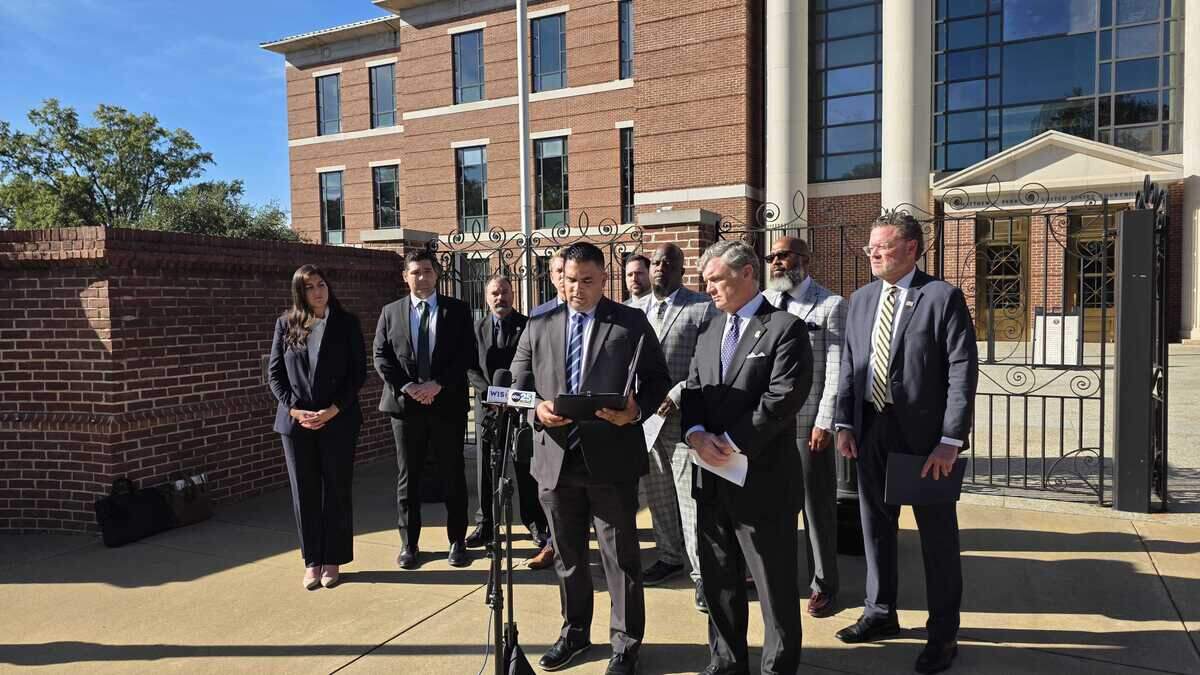
“Kimble orchestrated one of the largest international healthcare frauds in our nation’s history,” U.S. Attorney for South Carolina Bryan Sterling told reporters during a news conference Monday. “Today’s sentence underscores the seriousness of his crimes.”
Jose Carias, Assistant Special Agent in charge of the FBI Columbia Field Office, told reporters that crimes, like those committed by Kimble, “will not go unnoticed.”
“Today’s sentencing of Herbert Kimble delivers justice to one of FBI’s most wanted fraudsters,” Carias said. He was among the first fugitives placed on the FBI’s National Most Wanted Fraudsters list, an initiative designed to bring immediate attention to the most significant fraud threats.”
Read more President Donald Trump to host a midterm election rally in Rock Hill this week
Reporter John Monk contributed.