 By admin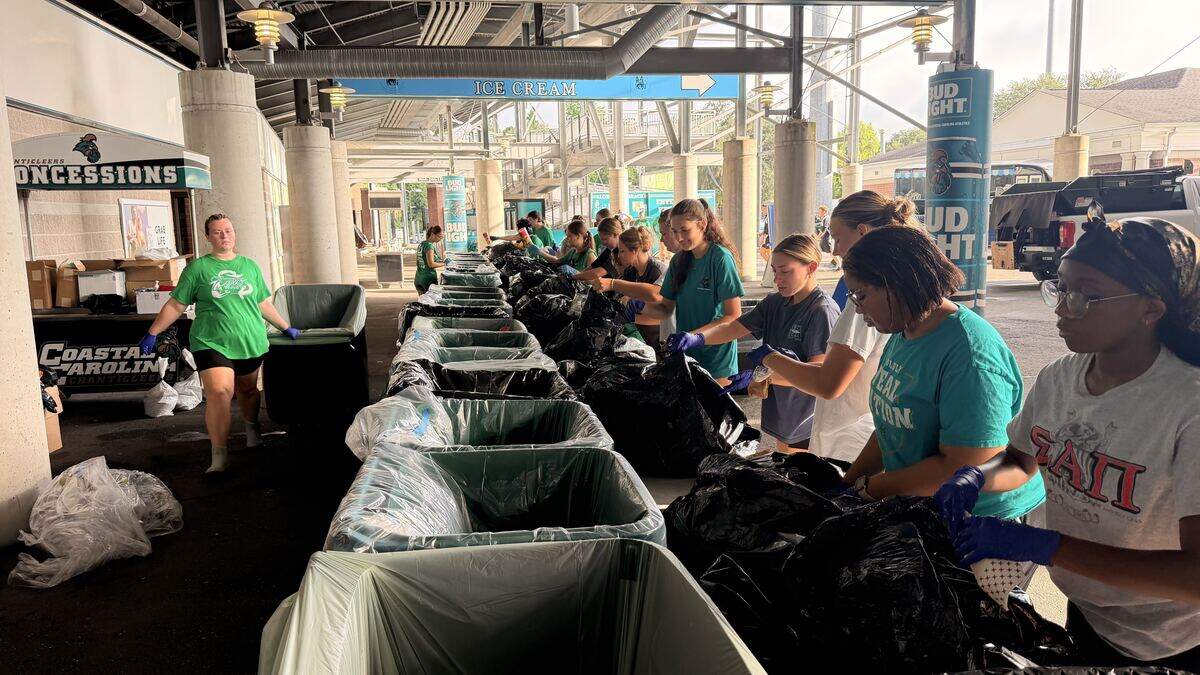
Over 30 student staff and volunteers entered Coastal Carolina’s Brooks Stadium Sunday morning, welcomed by the overwhelming stench of day-old beer and stale hotdogs.
Read more Are SC colleges protecting free speech? See which one does it best in the state
Bagged waste collected from the stadium seats after over 18,000 fans cleared from CCU’s home-opener football game Saturday night was piled inside Gate 2, standing nearly overtop the students’ heads.
It represented only half of the waste, most of which was covered in nacho cheese, that the students would spend the next four hours meticulously sorting, tossing items in designated bins for aluminum, recycling, compost and trash.
The effort is part of Coastal Carolina University’s Zero Waste program, in which the university recovers recyclable and compostable material and diverts it from entering Horry County’s landfill. The events are an attempt to extend the life of the landfill, which was denied an expansion earlier this year.
With over 12,000 students and about 1,000 faculty and staff, the university is one of the larger contributors to the county landfill, Director of Sustain Coastal Darcy Coughlan said.
Sustain Coastal, CCU’s sustainability program, has diverted over 62,500 pounds of waste from Zero Waste football games from entering the Horry County landfill since 2022, when the program began a more consistent data collection. The Zero Waste events grew from just one football game a year starting in 2015 to nearly every home football game, one basketball game and one baseball game a year.
“Not only is it really important from an environmental stewardship perspective, but once the landfill reaches capacity, it’ll make our jobs a lot harder and a lot more expensive, frankly, too, to be able to divert waste,” Coughlan said.
Students dig through beer cans, nacho trays for recoverable materials
With Prince’s tune “1999” bopping on a small, but projecting speaker, the volunteers got to work, sporting blue and purple latex gloves. The students parsed through aluminum Michelob Ultra cans, Tostitos chip bags and popcorn cups with occasional grimacing faces. They used their forearms to clear sweat accumulating on their foreheads.
Liquid, whether from half drank bottles or from what settled to the bottom of the trash bag, had to be poured into the drains under the sorting tables. Hot dogs cloaked in tin foil were individually unwrapped. The hot dog went to compost, and the tin foil was recycled.
Cheese-stained rally towels, that fans wave in the air during the game, are collected separately, washed and reused by people who may need them throughout the year, including for student projects.
Briana Curran and Lilly Bruder, both Coastal seniors, volunteered, along with members of their student organization Relay For Life. Sustain Coastal sells the aluminum collected during Zero Waste events and uses the funds to support student volunteer organizations who helped sort the waste. Along with students from Relay For Life, members from Habitat for Humanity and National Society of Leadership and Success attended Sunday morning.
As Curran and Bruder’s first time volunteering for a sort, they were expecting it to be dirty, but they were shocked by the volume of trash generated during the game.
“I feel like it’s something you don’t think you’re ever gonna do, and when you do, it kind of puts everything into perspective to see how much waste there really is,” Curran said.
Both Curran and Bruder said they would leave the experience with a different perspective on what they choose to consume and throw away, which is part of Sustain Coastal’s mission to educate the community on waste diversion.
How did Sustain Coastal start?
Sustain Coastal began in 2005 as a branch of Coastal Environments, which also includes custodial services and grounds. The sustainability program started with recycling at the university. There are over 350 recycling bins across campus.
When Horry County Solid Waste Authority began accepting food waste for composting in 2015, Coastal Environments Director Jeremy Monday wanted CCU to be one of the first in the community to participate. All dining halls began composting food waste, which is the largest contributor to the county landfill.
At the same time, Coastal’s football program was growing and attracted a larger crowd. One Zero Waste football game occurred every season.
Read more SC appeals court weighs transfer of man deemed incompetent in double-murder case
In 2019, Brooks Stadium expanded its west side. With more fans attending sporting events, Coastal now hosts Zero Waste games for most home football games, one basketball and one baseball game.
The university has a goal to reach a 50% diversion rate or better each year after 2030, meaning at least half of the waste generated would be diverted to recycling or compost. The university currently sits at a 35% to 38% diversion rate.
How much waste has been diverted from the landfill?
After each bin was filled, a student staff member rolled it to its next destination. Trash materials and recycling were each weighed on a large pet scale and recorded. Compost was wheeled to a dump truck parked outside the stadium gates, which would then be taken to the Solid Waste Authority’s composting facility and weighed. All the aluminum also gets weighed before it is sold.
“We weigh everything because that’s how we get our diversion rates,” Sustain Coastal Waste Diversion Coordinator Brooke Perkins said.
The diversion rate represents the volume of waste that was recovered in relation to what ends up in the landfill.
Of the 4,819 pounds of material generated from Saturday’s game, 3,367 pounds, or 70%, were diverted through recycling, composting or reuse.
Since 2022, Sustain Coastal managed more than 85,000 pounds of material through the Zero Waste football games. Over the last four years, season average diversion rates ranged from 67% to 80%. The record diversion rate reached 83% when Coastal played the University of Virginia in 2024.
During the 2025 football season, Sustain Coastal diverted 67% of waste generated across five home games. Coughlan said last year’s games produced the most amount of waste they’ve seen, largely due to the implementation of free concessions, where anyone with a ticket can get up to four food items per visit.
Brooklyn Cornwell, a junior sustainability major and a member of Sustain Coastal’s Green Team, said the free concessions has created a much larger work load during the Zero Waste sorts.
“What that means is that people are like, ‘Oh, this is so funny! I’m just gonna get whatever I want,’ and they get 10 hot dogs, and then they only eat like three of them, and so it ends up in the trash,” Cornwell said.
Since being a part of Sustain Coastal, Cornwell has become more mindful of how she sorts her own waste and tries to avoid single-use plastics.
Since 2015, CCU has composted nearly 2 million pounds of food waste from the entire campus that would’ve ended up in the landfill. Over 1,500 pounds of food waste was composted after Saturday’s game alone.
Monday and Coughlan said the ambitious goals wouldn’t be achievable without the collaboration from CCU Food Crew, Horry County Solid Waste Authority, Custodial Services and Grounds and other contracted vendors.
“We have a rapidly filling landfill, expansion or not,” Monday said. “At one point, the taxpayers of this county will have to see a change in where the place goes.”
Horry County Solid Waste Authority applied to expand the landfill earlier this year, but were denied funding from the county because the expansion would have filled 102 acres of wetlands. The county council redirected funding to improve recycling efforts and research transfer station feasibility to haul construction and demolition waste outside the county.
Read more Tractor trailer driver killed in early-morning crash on I-95, SC cops say