 By admin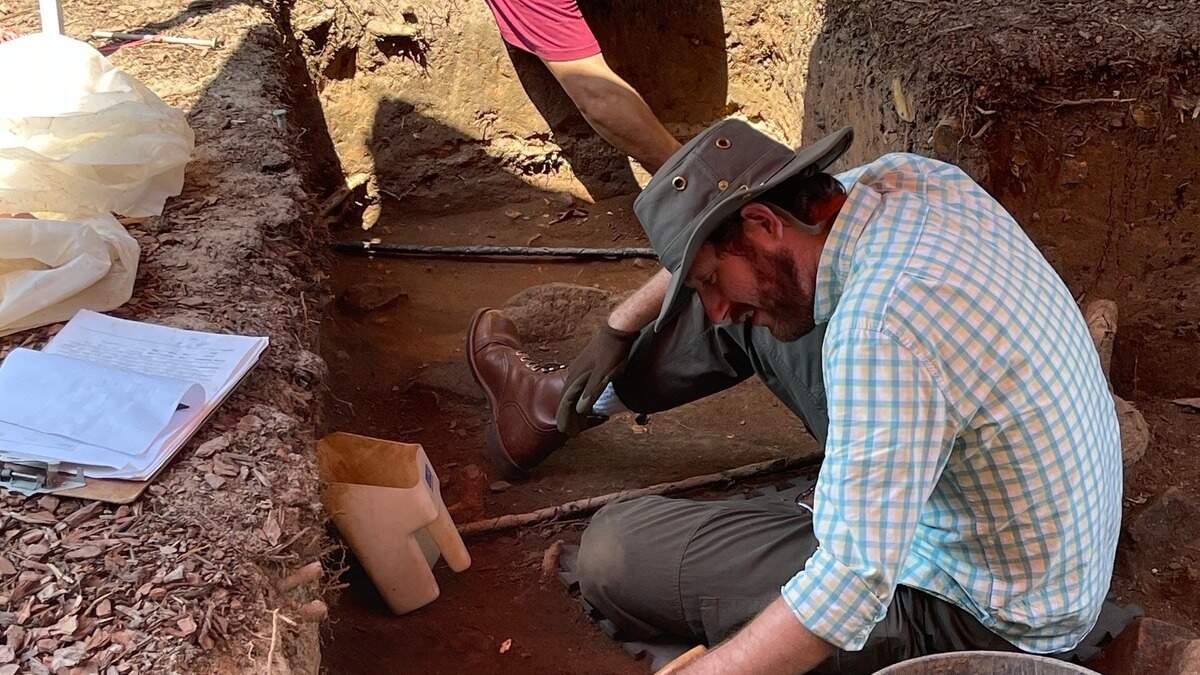
A ring of portable yellow barriers surrounds an active worksite at the head of the historic Horseshoe on the University of South Carolina campus. Inside, a handful of laborers dressed in bucket hats, gloves and work boots crouch in canopy-covered trenches churning up layers of dirt in the sweltering heat of a famously hot July afternoon.
Read more Organic fruit puree recalled because packaging defect can leave plastic in food
What might look from a distance like the early-stage construction of the university’s next big development project is actually the site of a multiyear archaeological excavation being conducted by USC students, faculty and community volunteers.
Led by Kelly Goldberg, a historical archaeologist and director of the university’s Public Heritage Lab, the dig seeks to unearth information about USC’s early history and raise awareness about the field of archaeology and the importance of protecting archaeological resources.
“I had been doing field schools out at Sesquicentennial State Park, and we thought, well, why not do some archaeology here on campus?” said Goldberg, an instructor in USC’s Honors College.
While school administrators initially had some reservations about letting students excavate part of the university’s historic core, they ultimately granted her permission to teach the hands-on class.
When the course launched during the Spring 2024 semester, it marked the first time in 51 years that archaeological research had been conducted in the heart of campus.
With the help of a couple 19th century maps and some preliminary shovel tests to see where artifacts were dispersed, Goldberg and her student field crew homed in on excavating the remains of an outbuilding behind the old president’s house that they believe served as a kitchen and living quarters for enslaved people in the early-to-mid 1800s.
They chose the outbuilding intentionally, Goldberg said, in the hope of learning more about the individuals who would have done the cooking, cleaning and washing for USC’s early presidents and their families.
“They’re not represented at all in the historical documents,” she said of enslaved laborers who were instrumental in the construction and daily operations of the university in its early years. “So we’re hoping to use that material culture to try to answer some of those questions about: What were they eating? What were they doing? What types of activities?”
Over the past 2 ½ years, field crews have excavated tens of thousands of artifacts at the site, located directly in front of the McKissick Building. They include a wide variety of processed animal bones, dishware, glass buttons and even children’s toys.
The personal objects are of greatest interest to Goldberg, whose own research explores sites of historical erasure within the African diaspora context.
“Things like our bone toothbrushes, our hairpins, our children’s toys — we have a marble, a doll leg, maybe a baby rattle — that really get that insight into daily life,” she said. “We are looking for the building and that’s important, but we’re looking for stuff about the people.”
Ryan Gomez, a 27-year-old Midlands Tech student who recently completed Goldberg’s intensive summer field school course, said uncovering artifacts that likely belonged to or were used by the enslaved workers filled him with a sense of importance.
“A big part of archaeology I like is being able to tell untold stories, and fill in gaps that are in the history books,” said Gomez, who grew up metal detecting for Civil War artifacts in his native Charleston.
Read more SC man gets life for killing a Lexington County bystander at Pine Grove Road home
He volunteers at the Horseshoe dig site in his free time, including last Friday, when he spent several hours troweling in a unit with multiple brick features believed to have once formed a path between the kitchen building and the old president’s house.
“It’s a treasure hunt, essentially,” said Gomez, who this summer parlayed his field experience into a seasonal job with an archaeological consulting firm.
Before finding his passion for archaeology, the soon-to-be second-year college student worked construction in downtown Charleston, where he got a front row seat to the destruction of cultural resources.
“You would just hear crunch, crunch, crunch … 300-year-old bottles just being crushed,” when the excavator pierced the ground at work sites, Gomez said.
The experience gave him an appreciation for the importance of surveying historically significant land for artifacts before embarking on new construction.
Raising that sort of cultural awareness, both among students and university staff, is one of Goldberg’s primary goals for the Horseshoe excavation.
She said she wants to get people thinking about the fact that historical relics are buried all around us, not just in far-flung, exotic places.
“What we’re trying to do here with campus is to get people thinking about: This is everywhere,” Goldberg said. “There’s no awareness of ‘Why should we preserve?’ ”
Students in Goldberg’s classes have not only gotten practice working in the field with shovels, trowels and sifting screens, they’ve also spent time in the lab cleaning, cataloguing and bagging artifacts.
With the Horseshoe excavation expected to wrap up later this summer, Goldberg is currently preparing for the next phase of the project: artifact curation and display.
This coming spring, she’ll be teaching an Honors College class where students will research objects unearthed at the Horseshoe, examine how other museums display artifacts with similarly fraught histories and create and install an exhibit on the first floor of the South Caroliniana Library.
“Archaeology is a service to the public.” Goldberg said. “We’re trying to learn this information to share it so that everyone knows.”
Read more SC man gets life for killing a Lexington County bystander at Pine Grove Road home