 By admin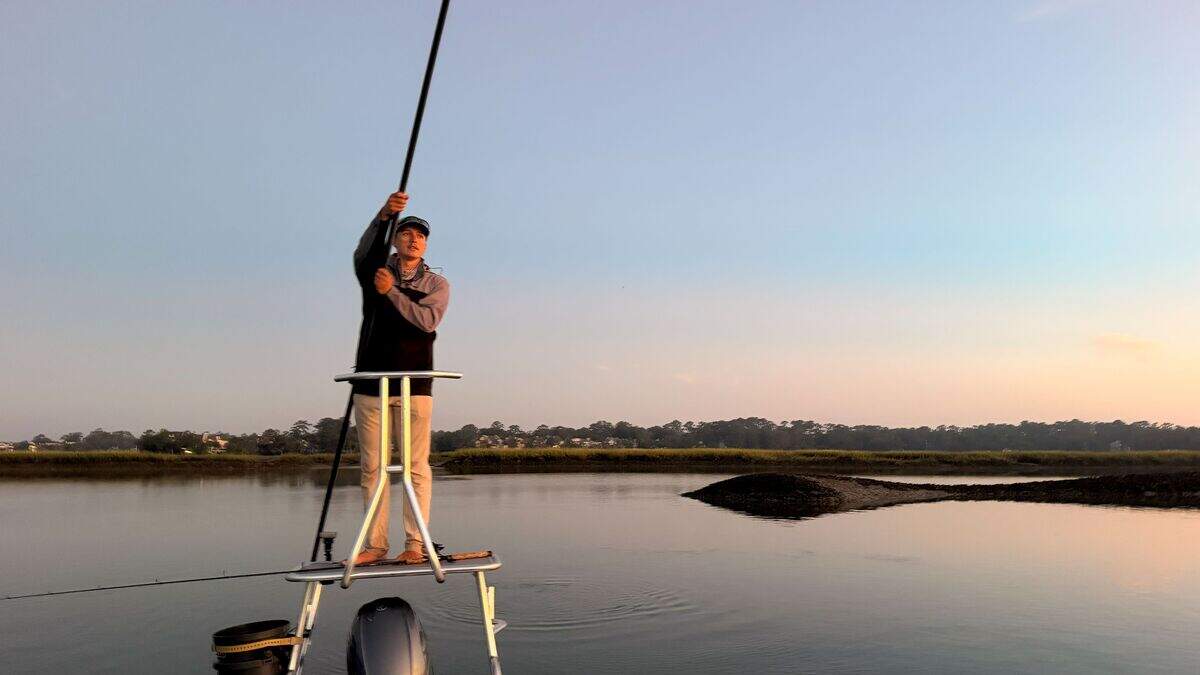
Capt. Zach Markow cut the motor of his flats boat, stepped atop a platform and used a 23-ft. pole to guide himself into the shallow marsh near Jarvis Creek. He stealthily crept up to the easily spooked redfish feeding at low tide.
Read more El Niño hype is loud. The numbers back it up, but here’s what they really mean
Markow heard the distinct sound of the fishes’ wake before he saw them, especially as the glare of daybreak reflected the sun rising off the calm waters.
Within a minute of casting his line, he reeled one in, grabbed its belly to unhook it and dropped it back to the water, a catch and release approach he’s taken to help protect the declining fishery.
“I don’t market myself as ‘We’re catching fish to eat,’” Markow said, who has operated Southern Style Charters for five years. “We’re doing it to have a good time out here. I’m showing you the environment, the scenery and catching fish as well.”
Redfish, also known as red drum or spottail bass, are South Carolina’s most targeted saltwater sport fish, known for their fight and accessibility in inshore waters. Although today 90% of anglers fishing for redfish are catch and release, the species’ population has declined for decades.
A 2024 stock assessment conducted by the Atlantic States Marine Fisheries Commission confirmed the species’ southern stock, from South Carolina to Florida, was overfished, and that overfishing was still occurring.
The northern stock, from New Jersey through North Carolina, was not overfished, and overfishing was not occurring, the assessment found.
An updated state law from July lowered bag limits for the beloved species to one fish per person and two per boat, per day. That’s a reduction from the two fish per person and six per boat, per day limit set in 2018.
Back when catch limits were set in 1993, there were roughly 3.5 million trips taken in state waters. In 2025, total trips were around 9 million.
That pressure on the fishery, along with some environmental changes to habitat, has resulted in only one year over the last 15 where mature redfish reproduced in healthy numbers, according to Ben Dyar, South Carolina Department of Natural Resources’ Office of Fisheries Management director.
Markow, who grew up in Charleston and moved to the Beaufort area for college, grew his business in the waters between the Sea Islands and Savannah, Georgia, because Charleston became too busy. He’s noticed the growth of the area and influx of people, and along with it, people on the water.
“Can’t blame them for wanting to do so,” he said. “But all the areas along the water that are pretty, like this, are getting blown up with people… and more people (are) using the resource as a whole.”
Redfish populations have cyclically declined for decades
The peak harvest of redfish occurred in the mid-to-late 1980s when there weren’t any bag limits in place. The culture was also quite different, Dyar said — most redfish that were caught were harvested.
It wasn’t until 1993 when the number of fish a person could catch were set in state statute, with a limit of five fish per person.
Populations began to rebound and level off. The limit was reduced to two fish in 2001 to further help the population. After what seemed to be a successful recruitment, limits were increased to three fish between the size of 15 to 23 inches, but a noticeable increase in fishing pressure again cause the population to drop.
In 2018, limits were reduced to two fish per person and six fish per boat, per day, with the same slot, or size of fish. Each state, including South Carolina, manages its own fisheries but requires legislation to set catch and slot limits.
Read more A woman was shot multiple times and there’s a search for the gunman, SC cops say
Since 2002, the Atlantic States Marine Fisheries Commission, from New Jersey to Florida, has assessed stocks and created guidelines for each state to follow, since fish species don’t know state borders.
After the 2024 southern stock assessment confirmed overfishing, each state in the southern region had to create limits that would reduce fishing pressure by 14.4%. That looks different for each state since there are varying numbers of anglers and other factors, said Tracey Bauer, fishery management plan coordinator for red drum for the Atlantic States Marine Fisheries Commission.
Georgia reduced its catch limit to from five to three fish per day, a rule that will go into effect Jan. 1, 2027. Florida has several different regulations per region, with most having one fish per person and two or four per boat. One of the state’s central regions is catch and release only.
The most recent limits in South Carolina were reduced to one fish per person and two fish per boat, per day with a slot limit of 18 to 25 inches. The size targets fish that have not yet been able to reproduce, and to leave the productive adult fish alone.
Importance of a healthy fishery to SC anglers
Joseph Ballenger, SCDNR senior marine scientist, oversees the state’s redfish stock enhancement program, which releases hatchery raised redfish into the state’s coastal waters. Since 1995, SCDNR has released about 40 million juvenile redfish, and over the last 10 years roughly 10-12% survived.
“With a high-quality stock enhancement program, we don’t want to see our contribution to the wild population become overly high. That means that there’s very little wild reproduction going on,” Ballenger said.
SCDNR estimates with the reduced limits and continued stock enhancement, the overfishing and an overfished stock should see recovery within seven years.
“It’s very long-lived fish, so that stock, once you take a lot of those fish out of the water, it can take a while for it to recover as well,” Bauer said.
Jason Woodham grew up on the water and has owned his own charter, Merrikhol Outfitters, in the Beaufort area for 16 years. Like many other anglers in the state, it’s how he makes a living. He’s seen first hand the decline in redfish populations, and overall said he supports the management decisions from SCDNR to protect the fishery.
But he built a lot of his clientele on groups who like to harvest fish to eat. As much as he applauds the guides who operate as strictly catch and release, he can’t turn away the majority of his business, he said.
He tries to make their experiences more that just what might end up on their plates.
“I hope that the job that I do, building my clientele, the harvesting of a fish of any species legally — I want it to be a bonus to what I’m offering them,” Woodham said.
While redfish is not in worse shape than many other species in the Atlantic, it’s certainly one of the most valued in South Carolina.
“Redfish, especially in the Lowcountry, that’s a staple fish,” Woodham said. “We definitely want to do everything we can to keep the dream alive and to keep future generations doing this.”
Read more SC doesn’t have many close ‘26 races. Why are potential ‘28 hopefuls visiting now?