 By admin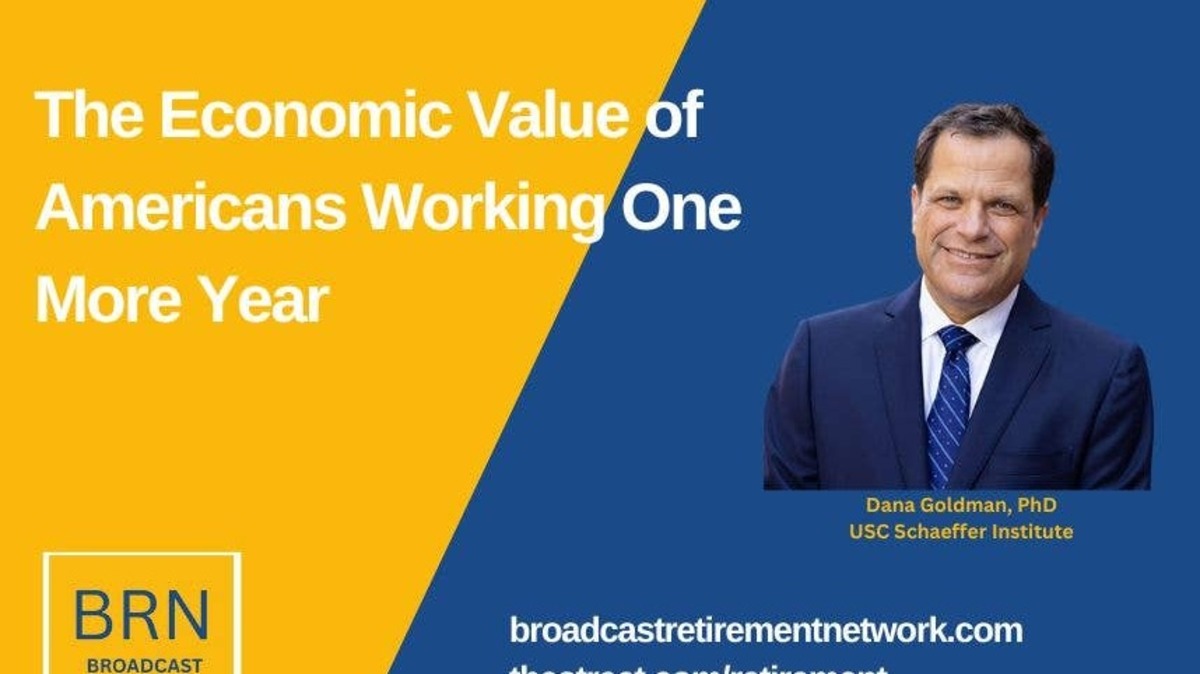
USC Schaeffer Institute’s Dana Goldman, PhD., discusses new research on aging, work, and public policy – and why updating retirement rules matters now.
Key topics covered:
- Why rising life expectancy demands policy updates to Social Security and retirement ages.
- How gradually delaying retirement can prevent big benefit cuts and improve fiscal solvency.
- The economic impact: delaying retirement by about one year per cohort could add roughly $1 trillion to the economy (~2–3% of GDP).
- Health and social benefits of continued work: many older workers experience better physical and mental health, social connections, and a sense of purpose.
- The importance of flexible work arrangements: partial work, role transitions, and workplace accommodations for older employees.
- Value of age-diverse teams: combining experience and youth boosts productivity and knowledge transfer.
- AI and the labor market: why older workers’ tacit knowledge and long-term perspective remain valuable even as AI reshapes jobs.
- Policy takeaways for lawmakers: gradual changes to retirement policies and supports for flexible work can benefit individuals and society.
Jeffrey Snyder, Broadcast Retirement Network
Well, Dr. Goldman, it’s great to see you. Thanks for joining us this morning.
Dan Goldman, PhD., USC Schaeffer Institute
Oh, it’s a pleasure to be here.
Jeffrey Snyder, Broadcast Retirement Network
And I love when we talk about research, and this is, I think, very unique research that you and the team have done. Doctor, we’re living longer than I think everyone knows that. We have the ability to thwart a lot of diseases.
That living longer allows us to do a lot more things, including work longer. You and the team did a lot of research in this area. There’s a lot of economic value, Doctor, if you can work a year longer.
Dan Goldman, PhD., USC Schaeffer Institute
Yeah, absolutely. And you have to set the policy context for this. You know, when we originally conceived, and the real policy issue is social security, as you’re well aware.
And when we initially conceived of that program, people were living 18 years fewer, 18 fewer years. And so it was really that a few people were living much longer than we thought, and we would have a social insurance program. And over time, what has happened is with, you know, biomedical progress, progress in public health, you know, people are living longer lives and healthier lives and our policy has not kept up.
Jeffrey Snyder, Broadcast Retirement Network
So in terms of, you know, if we’re informing, and I know the, I think the work was done to inform policy makers, and there’s a, you know, I think there’s a lot of conversation about social security because the trust fund is scheduled to be depleted sooner rather than later. It’s gonna, you know, they’re potentially cutting, they’re trying to look for solutions, I guess. So if you were to inform our policy makers in Washington, DC, what would you want them to take away from this research in particular?
Dan Goldman, PhD., USC Schaeffer Institute
Oh, well, you know, we faced this dilemma during the Reagan years. And, you know, this periodically comes up because, and what they decided was the gradual changes in the retirement age, and you may recall, it used to be 65, and we, over time, as a result of that 1983 commission, decided that we would gradually increase the age to 67, and that forestalled the, you know, the insolvency of social security. And now here we are, and six years from now, we face, as you said, these chances of, if we don’t do anything, there’s gonna be a 25%, almost a 25% benefit cut across the board, and we need some responsible policy changes.
And the reality is, if we do things gradually, we can ensure solvency, but inaction means that really dramatic things are gonna happen.
Jeffrey Snyder, Broadcast Retirement Network
So if we even extend, we, not me, but if we vote, if the policy makers determine, in their infinite wisdom, to extend the retirement age, say, from 67 to 70, there’s, that’s actually gonna benefit, not only themselves, but it’ll benefit society economically as well.
Dan Goldman, PhD., USC Schaeffer Institute
Yeah, no, so that’s the other part about this that you pointed out, our contribution to this research, and actually, we’re just synthesizing a lot of the work that other people do, which is, it’s good for a lot of people to keep working. Now, that’s not universally true, but for a lot of Americans, this notion that you just retire when you reach social security age, it misses the, often it’s the workplace where you have social interactions. There’s even some evidence that people who retire earlier will die sooner, and that’s a few months, but it’s, it approximates, we see evidence of both physical and mental health improvements for many people as a result of staying on the job.
So we’d like to think that everyone is retiring, and then they’re going out on the golf course and doing all this stuff, but it’s actually not the case. If you take the UPS driver, for example, that UPS driver is actually, has a pretty strenuous job, and that is literally exercise, and that person is exercising every day, and if they’re able to do it and continue to do it, it’s actually good for their health, and often, they’ll retire and say, you know what, I’m gonna sit on the couch because I haven’t done that for a while, and so we do see that the workplace has these improvements in physical health, and I already mentioned the social connections and the like, and so when you add all this up, the health benefits, and then also just the contribution to GDP, you’re talking about a trillion dollars if each of the retirees each year just delayed about one year in economic benefits.
So we’re talking about something on the order of two to 3% of GDP as a result of these changes, so they make a difference, and they make a difference for individuals, and they make a difference for society.
Jeffrey Snyder, Broadcast Retirement Network
And to your point, I mean, to pick up on your analogy of the UPS driver, it is a strenuous job, but the UPS driver, when he or she retires or works an additional year, they don’t have to do the same thing. They can maybe move to an office job within UPS. Maybe they have a passion for teaching music, so they can transition, so it’s not, or is it?
Is it staying in the same role, or can you transition to do something else?
Dan Goldman, PhD., USC Schaeffer Institute
No, you make an excellent point that we need to modify. That’s another policy change that we could do is figuring out partial work and the ability to modify the work environment in order to accommodate workers at older ages and to overcome some of the biases against hiring older workers. I mean, and they are biases, because a lot of these people are extremely dedicated and can do quite well in the workplace, and Walmart saw that, for example, early on.
And so you’re right on that that’s another policy change to better accommodate the ability to work in different roles and fewer hours.
Read more SC man slapped with attempted murder charges after resisting police, SLED says
Jeffrey Snyder, Broadcast Retirement Network
And we bring us older workers, mature workers, as we like to say, not older, mature. We bring a lot of skills that maybe the younger generations maybe don’t have. I think a lot more qualitative.
I think we’re good at team building. You know, we came up, I came up in a world, doctor that had fax machines, and we actually had to go to meetings. This is before, the internet was just in its infancy.
So there are skills and leadership skills that I think, you know, I think employers probably don’t want to lose that body of knowledge that people have gained. That is very advantageous to a lot of organizations.
Dan Goldman, PhD., USC Schaeffer Institute
There’s some interesting research on this where people have looked at teams, production teams in manufacturing settings. And what you find is that teams that have a diversity of ages, so going from young to old, are the most productive on the factory floor. It’s not all old people or all young people.
It’s actually a mix. And so, you know, that type of, so you should, the point is, it’s not all we should just make room for the young workers. We need both the experience and wisdom that comes with people who’ve been doing a job a while, as well as young people.
Jeffrey Snyder, Broadcast Retirement Network
I’m sorry to interrupt you. I was gonna make a quip that, you know, almost like the Oracle, the Oracle of Delphi being able to guide people, that’s of exceptional value. Let me ask you, in the remaining minutes that we have, I wanted to ask you about, and this is not in the research, but you can’t go without turning on the television or reading a social media feed without talking about artificial intelligence.
Does this in some way dovetail into your research in terms of reskilling older workers, mature workers, or adding additional value that may be going beyond the trillion dollars that you were articulating in the report?
Dan Goldman, PhD., USC Schaeffer Institute
Yeah, so, I mean, AI is a challenge, generally, to the labor force. But I also think you talked, you hit on it, that when you said the Oracle, there’s a certain wisdom that is associated with work. And actually, I’m more worried about the younger workers who don’t have that wisdom, and they, you know, can be replaced.
Now, you know, who knows how disruptive this is gonna be. But I think the fact that in many ways, older workers have some experience that, you know, large language models right now can’t reflect. I mean, the extreme of this is just having the memory of what existed, like you said, during the era of fax machines.
We actually were learning things before we had the internet, and all they can do is scrape the internet, so.
Jeffrey Snyder, Broadcast Retirement Network
Yeah, well, that was before Wikipedia. You know, I actually, my parents bought me the encyclopedia, no, it was the World Book Encyclopedia. And we had that, and that’s where we had to do our research.
I actually had to go to a library. And by the way, I started typing on a typewriter before I did anything. Well, doctor, we’re gonna have to leave it there.
Great research. Thank you so much for joining us in the program. And look, we look forward to having you back again very soon, sir.
Dan Goldman, PhD., USC Schaeffer Institute
Thank you, and thank you for all you’re doing for the retirement community, so.
The Arena Media Brands, LLC THESTREET is a registered trademark of TheStreet, Inc.
Read more There’s a new Miss South Carolina 2026. Here’s who won